
Depression Up Close: The Scientific Answers Every Patient Should Know
- Health Communicator

- Jun 22
- 6 min read
Updated: Sep 3
AUDIO:
This article provides answers to some of the most important questions that people with depression and their loved ones may ask. All answers are based exclusively on the comprehensive review "Major Depressive Disorder: Advances in Neuroscience Research and Translational Applications," published in 2021 in the journal Neuroscience Bulletin (Volume 37, Issue 6, pages 863–880). The article was authored by a team of researchers and clinicians: Dr. Zezhi Li, Dr. Meihua Ruan, Dr. Jun Chen, and Dr. Yiru Fang, affiliated with leading institutions for mental health research and treatment – the Shanghai Mental Health Center at Shanghai Jiao Tong University School of Medicine, the Shanghai Institute of Nutrition and Health, and the Center for Excellence in Brain Science and Intelligence Technology (Chinese Academy of Sciences). The authors summarize the most current scientific findings on the causes, biological mechanisms, diagnosis, and treatment of depression, with a focus on recent advances in neuroscience and clinical approaches.


Expert Insights
Depression is one of the most common and severe mental illnesses, affecting millions of people worldwide. It is characterized by persistent sadness, loss of interest or pleasure, fatigue, sleep and appetite disturbances, and, in more severe cases, suicidal thoughts. According to the World Health Organization, depression has been the third leading cause of years lived with disability (YLDs) since 2008 and is projected to become the number one cause by 2030.
In the following expert insights, you’ll find five key aspects derived from the latest research and global clinical expertise. Each insight is accompanied by explanations and guiding questions to help patients and their families better understand the complexity of depression, modern treatment trends, and what individual solutions may be possible.
1. What Are the Latest Scientific Views on the Causes and Development of Depression?
"The etiology of depression is still not clear, but it is generally believed that MDD is a multifactorial disease caused by the interaction of social, psychological, and biological aspects. Therefore, there is no exact pathological theory that can independently explain its pathogenesis, involving genetics, neurobiology, and neuroimaging."
Explanation: Depression is an extremely complex illness—not merely a “chemical imbalance” or a purely psychological issue. Genetic predispositions, changes in brain structure and function, neurotransmitter systems, chronic stress, and social factors (isolation, trauma, poverty) all intertwine. This complexity explains why treatment often requires a multidisciplinary approach—medications, psychotherapy, and social support.
2. What Neurobiological Mechanisms Are Most Important in the Development and Treatment of Depression?
"So far, selective serotonin reuptake inhibitors and norepinephrine reuptake inhibitors are still the first-line antidepressants. However, there remain 1/3 to 2/3 of depressed patients who do not respond satisfactorily to initial antidepressant treatment, and even as many as 15–40% do not respond to several pharmacological medicines. Therefore, the underlying pathogenesis of depression is far beyond the simple monoamine mechanism."
Explanation: Antidepressants typically target serotonin and norepinephrine. However, a significant number of patients don’t respond to these medications, indicating that other biological mechanisms are at play—such as dysregulation of the stress response (HPA axis), impaired neurogenesis, inflammatory processes, and gut-brain interactions. This has led researchers to explore new drugs and more individualized treatments.
3. What Role Do Inflammation and the Immune System Play in Depression?
"Patients with depression show the core feature of the immune-inflammatory response, that is, increased concentrations of pro-inflammatory cytokines and their receptors, chemokines, and soluble adhesion molecules in peripheral blood and cerebrospinal fluid."
Explanation: Modern research shows that inflammation in the body plays a major role in the development and persistence of depressive symptoms—especially in people with autoimmune or chronic illnesses. Lab tests often reveal elevated levels of cytokines such as IL-6 and TNF-α. New approaches include studying anti-inflammatory drugs as an add-on therapy for treatment-resistant depression.
4. What Is the Current Role of Brain Imaging and Biomarkers in Diagnosis and Prognosis?
"MRI can provide important data on brain structure, function, networks, and metabolism in patients with depression... the hippocampal volume plays a critical role in the development, treatment response, and clinical prognosis of depression... However, the development of reliable diagnosis for MDD using biomarkers is still difficult and elusive, and all methods based on a single marker are insufficiently specific and sensitive for clinical use."
Explanation: Advanced brain imaging techniques (MRI, fMRI, PET) reveal changes in brain regions like the hippocampus and prefrontal cortex. In some patients, these changes can help refine diagnosis and predict treatment response. However, there is still no “gold standard” biomarker that can independently diagnose depression or guide treatment—more complex research is needed.
5. What Are the Latest Trends in Treatment, and What Can Patients Expect from Modern Medicine?
"In 2019, the FDA approved two new antidepressants: Esketamine for refractory depression and Brexanolone for postpartum depression... However, although most antidepressants are usually safe and effective, there are still some limitations, including delayed efficacy (usually 2 weeks) and side-effects that affect the treatment compliance."
Explanation: Depression treatment is continually evolving. Beyond traditional medications, there are now innovative options like esketamine and brexanolone. New strategies also include precision (personalized) medicine based on each patient’s genetic, biological, and psychological profile. Still, treatment takes time and often requires multiple attempts to find the most effective approach. Support from family, therapists, and healthcare providers is crucial.
Q&A Section
1. How Common Is Depression, and Does It Affect People of Different Ages?
Answer: Depression is highly prevalent worldwide, though its frequency varies by country and age group. For instance, annual prevalence is as low as 0.3% in some countries (like the Czech Republic), while it’s around 10% in the U.S. Lifetime prevalence ranges from 1% (Czech Republic) to 16.9% (U.S.). Among American adolescents (ages 13–18), 11% have experienced depression at least once. In contrast, lifetime prevalence among adults in China is about 2.8%.
2. What Other Health Conditions Are Commonly Seen Alongside Depression?
Answer: Many people with depression also struggle with other health issues. Depression often co-occurs with mental disorders (like schizophrenia and epilepsy) as well as physical illnesses (such as stroke, cancer, diabetes, cardiovascular diseases, and Parkinson’s disease). Clinical trials increasingly focus on depression in the context of comorbid conditions, highlighting the importance of treating the whole person—not just the mental symptoms.
3. Is It Worth Getting Tested for Genetic or Epigenetic Factors If No One Else in My Family Has Depression?
Answer: Genetic studies show that depression results from interactions between many genes and environmental factors. Heritability is estimated at about 37%, meaning most people won’t have a single “depression gene.” Even without family history, depression can still develop due to major stress, trauma, chronic illness, or changes in how genes are activated or deactivated (epigenetics). Feelings of guilt or hopelessness about lacking a family history are unfounded—genetics is just one piece of the puzzle.
4. Can Probiotics or Dietary Changes Help With Depression?
Answer: Recent studies suggest that gut microbiota (the bacteria in your digestive system) can influence brain function, mood, and behavior. Changes in gut composition are often seen in people with depression. In animal studies, transferring microbiota from depressed humans led to depression-like behavior. Some probiotics have been shown to alleviate symptoms in animals and, in small human trials, as well. While more research is needed before recommending probiotics as standard treatment, diet and gut health may play a role.
5. Is There Hope for Personalized Treatment, and What Does That Mean?
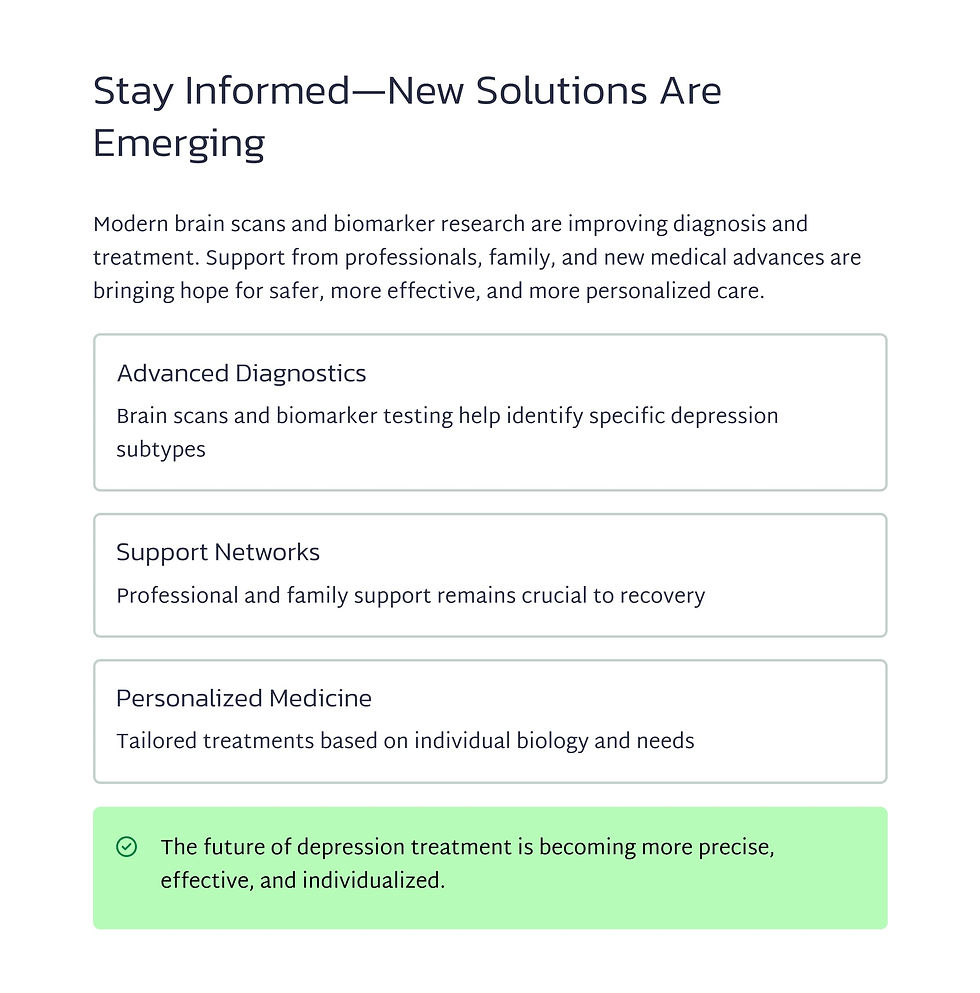
Answer: Personalized medicine for depression is a growing field. In the future, treatments may be tailored to individual characteristics—like genetics, brain imaging findings (e.g., MRI), and blood-based biomarkers. Clinical trials show that patients whose antidepressants are selected based on genetic profiles are more likely to improve and reach remission. Although not yet widely available, this direction offers promising hope for safer, more effective therapies suited to each individual.
Conclusion
The modern scientific insights presented in the work of Li, Ruan, Chen, and Fang clearly show that depression is a complex, multifactorial illness requiring an individualized and comprehensive approach—both in diagnosis and treatment. Understanding the wide range of biological, genetic, immunological, and psychosocial factors allows patients and their families to make better-informed healthcare decisions. Advances in neuroscience and clinical research offer growing hope for more effective, personalized therapies tailored to each person’s unique needs. Evidence-based knowledge is the key to better managing depression and improving quality of life.
Sources Li, Z., Ruan, M., Chen, J., & Fang, Y. (2021). Major Depressive Disorder: Advances in Neuroscience Research and Translational Applications. Neuroscience Bulletin, 37(6), 863–880. https://doi.org/10.1007/s12264-021-00638-3


Comments