
Stroke Today: New Treatment Options and Hope
- Health Communicator

- Jun 22
- 5 min read
Updated: Sep 3
AUDIO:
In this article, you’ll find answers to key questions commonly asked by patients with ischemic stroke and their loved ones. The information is entirely based on the summary and recommendations of the review publication “Treatments in Ischemic Stroke: Current and Future,” published in the journal European Neurology in 2022. The authors are Dr. Maria Giulia Mosconi and Prof. Maurizio Paciaroni—experts in cardiology, emergency medicine, and stroke—working at the University of Perugia and the Santa Maria della Misericordia University Hospital in Perugia, Italy. They summarize the latest data, established guidelines, and experimental therapies that shape the modern approach to treating ischemic stroke—one of the most serious public health challenges of the 21st century.
“Modern medicine is expanding the treatment window—new therapies, technologies, and personalized approaches are giving more stroke patients a chance at recovery.”


Expert Insights
1. What is most important for preventing an ischemic stroke?
“Ninety per cent of all strokes worldwide could be prevented with stricter primary prevention of recognized modifiable risk factors: hypertension, smoking, obesity, diet, physical inactivity, diabetes, alcohol intake, psychosocial factors, cardiac disease, and apolipoprotein ratios...”
Explanation: The vast majority of strokes can be prevented through strict control of risk factors such as high blood pressure, smoking, obesity, diabetes, stress, and more. This means prevention is crucial—not only for those with a family history or past stroke, but for everyone in at-risk groups.
2. What are the latest options for acute therapy in ischemic stroke?
“To date, the only approved drug for acute ischemic stroke is intravenous thrombolytic alteplase... Tenecteplase is a promising alternative fibrinolytic agent, having a better safety profile than alteplase. Moreover, recent evidences have allowed an extension of the IVT ± EVT time window for patients with unknown onset time and for those with a known onset time thanks to the new ‘tissue-window’ approach guided by advanced neuroimaging techniques…”
Explanation: Alteplase remains the "gold standard" medication for acute ischemic stroke, but safer alternatives such as tenecteplase are emerging. Modern imaging techniques—such as the so-called "tissue-window" approach using advanced CT or MRI perfusion imaging—make it possible to treat patients even when the exact time of onset is unknown or outside the usual window. This includes so-called "wake-up" strokes (where patients wake up with symptoms). This expands the number of patients eligible for treatment.
3. What is the role of mechanical thrombectomy, and when is it used?
“EVT with MT within 6 h from symptom onset is known to be safe and effective in reducing neurological disability when administered in AIS patients affected by a large cerebral artery occlusion... Recent evidences have allowed an extension of the IVT ± EVT time window for selected patients... between 6 and 24 h from time last known well and fulfilling the selection criteria of DEFUSE-3 or DAWN, recommend MT plus best medical management…”
Explanation: Mechanical thrombectomy—the physical removal of a clot from a major brain artery—is proven to be effective within the first 6 hours after symptom onset. For selected patients, identified using advanced imaging, the treatment window can be extended to up to 24 hours. It's crucial for patients to reach specialized stroke centers quickly for this treatment to be possible.
4. Are there advances in medications for secondary prevention, and what are the risks?
“Despite the demonstrated benefit-risk profiles associated with DOACs, the development of drugs with better safety-efficacy profiles for primary and secondary prevention for nonvalvular AF is a major clinical need… Data on coagulation factor deficiency, both in animal models and in humans, suggest that factor XI (FXI) deficiency is associated with a nonsignificant incidence of bleeding and a lower risk of ischemic events…”
Explanation: Modern direct oral anticoagulants (DOACs) are safer than traditional drugs like warfarin and are recommended for patients with atrial fibrillation. However, they still carry some bleeding risk. That’s why newer, more targeted molecules are in development—such as drugs that target coagulation factor XI—which aim to prevent stroke with minimal bleeding risk.
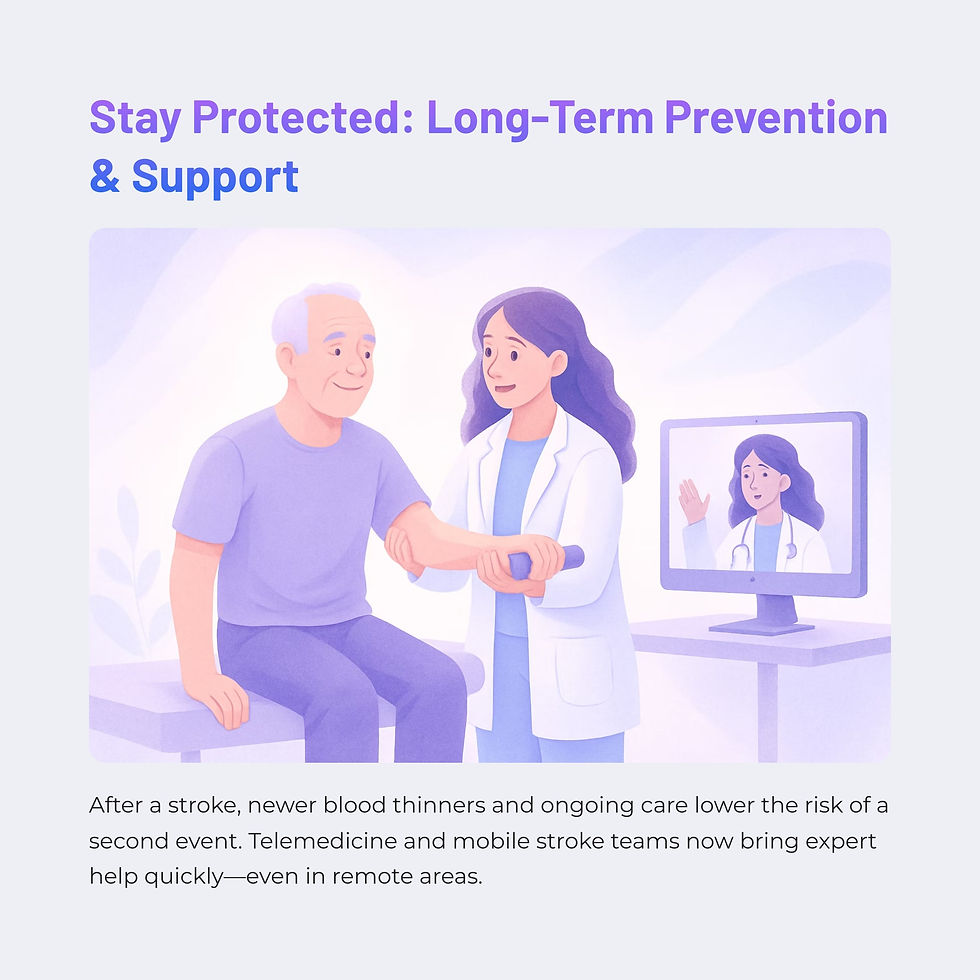
5. What is the role of telemedicine and mobile stroke units in modern treatment?
“Telestroke and mobile stroke units should be implemented to speed up pre-hospital management and to implement stroke medicine in deficient or rural areas. A greater use of telestroke should be encouraged in order to improve in stroke assessment, from the outpatient to the inpatient level, but also in the follow-up.”
Explanation: Telemedicine (“telestroke”) and mobile stroke units enable faster diagnosis and treatment—especially in areas without large hospitals or on-site neurologists. This can significantly reduce the time to treatment, which is critical for a good outcome in stroke.
Questions & Answers
1. How urgent is it to start treatment for ischemic stroke, and what does the “treatment window” mean?
Answer: Time is critical— the earlier thrombolytic therapy (with a drug like alteplase) is started, the better the chances for recovery. Standard treatment with alteplase is recommended within the first 4.5 hours of symptom onset. For mechanical thrombectomy (removing the clot with a special catheter), the standard window is up to 6 hours, but for selected patients—after special imaging—it can be extended to 24 hours. New imaging techniques help evaluate brain tissue condition and offer treatment options even when the stroke’s onset time is unclear (for example, if you wake up with it).
2. If I receive treatment, what are the possible complications, and what are my chances of recovery?
Answer: The main concern with thrombolytic therapy is the risk of intracranial hemorrhage (symptomatic brain bleeding occurs in 2–7% of treated patients). However, only 10–20% of all patients actually receive thrombolysis due to time limits, hospital access, or contraindications. Even after successful clot removal (recanalization), some patients don’t fully regain function—this is called “futile recanalization,” and is due to additional damage from inflammation and impaired microcirculation. About half of all stroke survivors are unable to fully regain their independence.
3. What can I do after a stroke to reduce the risk of another one (secondary prevention)?
Answer: If your stroke was caused by atrial fibrillation (a type of arrhythmia), direct oral anticoagulants (DOACs)—such as apixaban, dabigatran, edoxaban, or rivaroxaban—are recommended because they reduce the risk of recurrent stroke with less bleeding risk compared to traditional drugs (like warfarin). If your stroke wasn’t related to arrhythmia, aspirin is usually prescribed. In certain cases, dual antiplatelet therapy (for example, aspirin + clopidogrel) is recommended for a specific period, especially after a minor stroke or transient ischemic attack (TIA), and then followed by monotherapy.
4. Are there new experimental therapies or ways to improve recovery after a stroke?
Answer: Currently, studies are underway on stem cells (mainly mesenchymal stem cells), which have potential to stimulate brain tissue recovery. Although early results in lab and preliminary clinical studies are promising, there is no conclusive evidence yet that this approach leads to significant functional recovery in humans. More large-scale studies are needed to determine the role of stem cells in ischemic stroke therapy.
5. What new technologies are available for diagnosis and support in small or remote communities?
Answer: Telemedicine (“telestroke”) and mobile stroke units are being increasingly implemented. Through video consultation with specialists and rapid imaging diagnostics, treatment decisions can be made even when patients are far from specialized centers. This allows for faster therapy initiation and improves outcomes—especially in rural and underserved areas. According to the data, outcomes for patients treated via telemedicine are comparable to those in major hospitals.
Conclusion
In summary, modern medicine offers increasingly effective and personalized options for diagnosing, treating, and preventing ischemic stroke. Advances in telemedicine, new drug molecules, and experimental therapies such as stem cells offer hope for better outcomes for more patients. As Dr. Mosconi and Prof. Paciaroni emphasize, awareness and timely response remain critical for a positive outcome, and future research will continue to expand the boundaries of treatment and recovery after stroke. All the data and recommendations presented here are entirely drawn from the review article by Mosconi & Paciaroni (2022), which provides one of the most up-to-date scientific overviews on this important public health issue.
Source: Mosconi MG, Paciaroni M. Treatments in Ischemic Stroke: Current and Future. Eur Neurol 2022;85:349–366.


Comments