
Type 1 Diabetes: The End of One-Size-Fits-All Treatment and the Dawn of Personalized Medicine
- Health Communicator

- Jun 22
- 5 min read
Updated: Jul 9
Type 1 diabetes (T1D) is now one of the most actively researched autoimmune diseases of our time, affecting millions of people worldwide—including an increasing number of children and young adults. For decades, treatment centered almost exclusively on insulin replacement therapy—a standard, uniform approach that often fails to meet the unique needs of every individual patient.
But today, modern science is uncovering the incredible complexity of this disease, from its diverse causes and progression patterns to the ways it manifests in different people. In recent years, breakthroughs in our understanding of genetic risk factors, immune mechanisms, and environmental influences have led to a new medical paradigm: personalized medicine. This approach promises the “right treatment, at the right time, for the right patient”—a concept that is already transforming how we diagnose and treat type 1 diabetes.
In the expert insights and research summaries below, you’ll find the most important information patients and their loved ones need to understand the scientific path toward individualized care for type 1 diabetes.



Expert Insights
This article highlights key, evidence-based recommendations from leading specialists, drawn from the publication “Diagnosis and treatment of type 1 diabetes at the dawn of the personalized medicine era” in the Journal of Translational Medicine. The focus is on improving the quality of life for people living with type 1 diabetes by exploring the roles of genetics, personalized therapies, and proven treatment strategies.
1. Why is “one-size-fits-all” no longer enough for type 1 diabetes?
“Currently, standard treatment for type 1 diabetes is external insulin replacement, but this approach doesn’t achieve optimal blood sugar control in many patients… With our improved understanding of the early stages of the disease, stratification methods, and genetic influences, T1D is emerging as an ideal candidate for personalized medicine—an approach that seeks to provide ‘the right therapy, at the right time, for the right patient.’”
What this means: Insulin therapy alone isn’t equally effective for everyone because type 1 diabetes is extremely diverse. People develop the disease for different reasons, experience it differently, and respond differently to treatment. Personalized medicine aims to tailor therapies to the individual, based on genetic, immune, and other personal factors.
2. What role does genetics play in predicting and diagnosing type 1 diabetes?
“T1D is a potentially life-threatening, multifactorial autoimmune disorder caused by T-cell-mediated destruction of pancreatic beta cells, leading to insulin deficiency. The disease has a strong genetic component, as seen in the 70% concordance rate in identical twins and an 8–10% risk among siblings. Much of this risk is associated with variations in specific HLA region genes… Genome-wide association studies (GWAS) and candidate gene studies have identified additional genetic markers beyond the HLA region that either increase or reduce risk.”
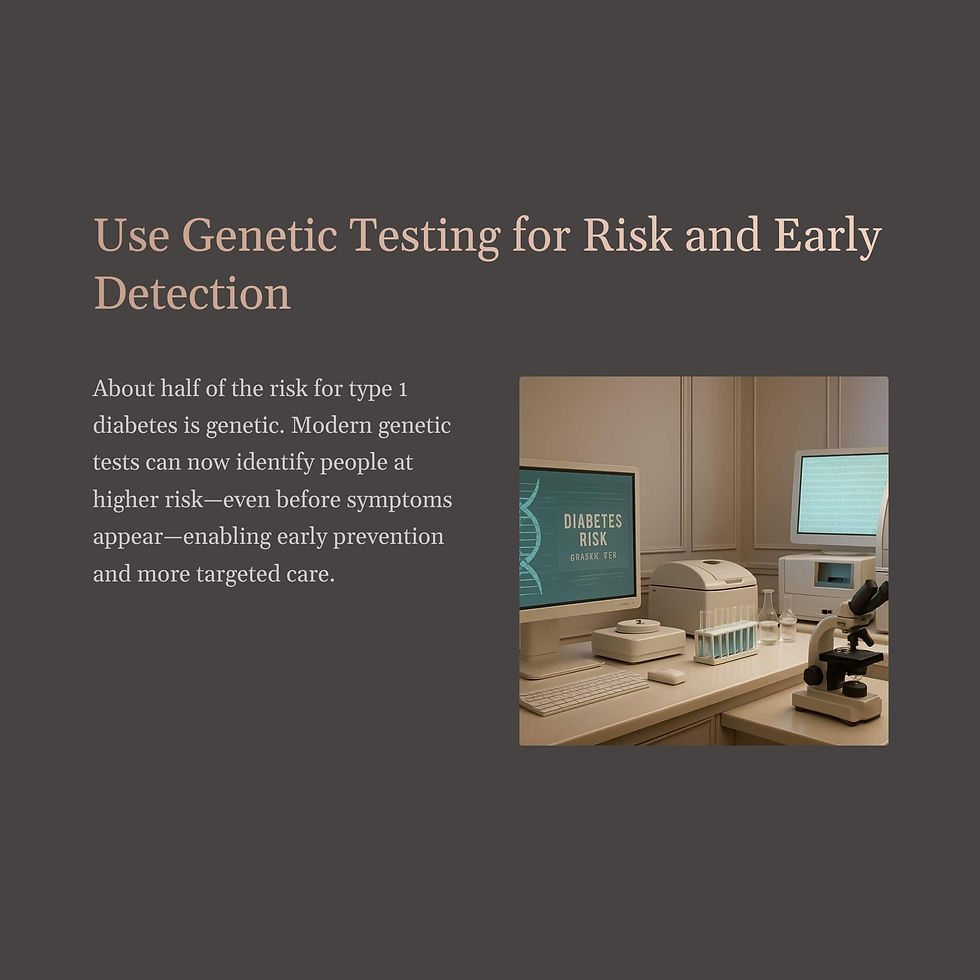
What this means: About half of a person’s risk for developing T1D comes from their genes—especially those in the HLA region of chromosome 6. Genetic testing tools like Genomic Risk Scores (GRS) are becoming more accurate at assessing this risk and can help detect the disease earlier. That opens the door to early prevention strategies, even before symptoms appear.
3. Does early detection matter? What are the benefits of early screening?
“Children tracked in long-term, prospective studies had better metabolic outcomes around the time of diagnosis and afterward, which made disease management easier, reduced episodes of hypoglycemia, and slowed the progression of complications. Starting diabetes care early increased the likelihood of a so-called ‘honeymoon phase,’ preserved higher C-peptide levels, and lowered mortality—suggesting that earlier intervention leads to better long-term outcomes.”
What this means: Kids who are identified early—especially if they’re in a high-risk group—tend to manage their diabetes better and experience fewer complications. This shows how valuable screening for autoantibodies and genetic risk markers can be in detecting pre-symptomatic stages of the disease and beginning treatment early for better results.
4. What are the new approaches in treatment—like stem cells, gene therapy, and the artificial pancreas?
“Innovative methods for improving insulin-mediated glucose control are becoming available to patients, while tissue transplants, genetic modification, and stem cell therapies show promising results in preclinical and early clinical studies for select patient subgroups… Breakthroughs in stem cell therapy offer hope for regenerating pancreatic tissue in some individuals.”
What this means: In addition to insulin therapy, new technologies are in development:
Artificial pancreas systems (combining insulin pumps with continuous glucose monitoring and AI-based control algorithms)
Gene therapies (adding or correcting genes to restore beta cell function)
Stem cell therapies (regenerating or replacing damaged insulin-producing cells)
These innovative treatments are still being tested but may become more widely available in the future, especially through personalized treatment plans.
5. What’s the future of personalized medicine for type 1 diabetes—and what challenges remain?
“The past decade has seen major advances in personalized diagnosis and treatment for T1D, but significant obstacles remain between what we know now and what can be widely used in clinical practice… The first step will be routine subtyping of new T1D cases, including monogenic diabetes screening and autoantibody testing, and eventually genetic profiling to identify candidates for gene or stem cell therapy.”
What this means: Despite exciting progress, challenges like cost, access to new technologies, and the need for more clinical trials still stand in the way of making personalized T1D care a standard. The future will likely include broader screening, genetic testing, and advanced diagnostics that help guide more precise treatments for each patient.
Q&A: What Patients Want to Know
1. Can I find out if I’m at risk for type 1 diabetes before symptoms appear?
Yes. Genetic testing, autoantibody screening, and other biomarker tests can help identify people at risk for developing T1D—often before symptoms show up. This early detection allows for closer monitoring, preventive action, and even early treatment, which can improve long-term outcomes.
2. What’s new in treatment beyond insulin injections?
In addition to traditional insulin therapy, new technologies are on the horizon:
Automated insulin delivery systems (a.k.a. artificial pancreas)
Combining insulin with other drugs like GLP-1 agonists or SGLT2 inhibitors
Experimental approaches such as gene editing and stem cell therapy These options may lead to better blood sugar control and fewer complications in the future.
3. Could these new therapies mean I won’t need insulin someday?
In some early-stage clinical trials, patients treated with stem cells or gene therapy have achieved normal blood sugar levels without insulin. While these approaches are promising, they’re not yet widely available or approved for routine use—so for now, most people with T1D still need insulin.
4. What can I do to better manage my diabetes?
Get to know your condition. Monitor your blood sugar regularly, stay consistent with your treatment, and work closely with your healthcare team. Personalized care also means speaking up—discuss your goals, symptoms, and options with your provider. Early and intensive treatment, a tailored diet, and regular check-ups all help reduce complications and improve your quality of life.
5. What does the future hold—will treatment be standard or individualized?
We’re moving steadily toward more personalized care. Your genetic profile, disease stage, and other factors will help determine the most effective treatment for you. Science has shown that there’s no such thing as “one kind of diabetes,” and future treatments will increasingly be customized to each person’s biology.
Conclusion
We’re witnessing a true revolution in how we approach type 1 diabetes—from generic therapies to individualized care based on each person’s unique genetic, immune, and metabolic characteristics. While personalized medicine still faces hurdles like the need for widespread screening, access to advanced technologies, and more clinical research, the progress is undeniable.
Even today, scientific advances offer real hope: that people with type 1 diabetes will not only live longer but also enjoy better quality of life through treatments designed just for them. The guiding principle is clear: science is on the patient’s side, and the path to personalized care is already unfolding.
Source: Akil et al. (2021). “Diagnosis and treatment of type 1 diabetes at the dawn of the personalized medicine era,” Journal of Translational Medicine, 19:137. DOI: 10.1186/s12967-021-02778-6


Comments